 Oracle
 Snowflake
 Alibaba
Marketplace revenue,
reconciled without a spreadsheet.
Usage collected from your product or your metering platform, priced against the plan the buyer actually bought, reported to the marketplace, and matched back to the money that lands.
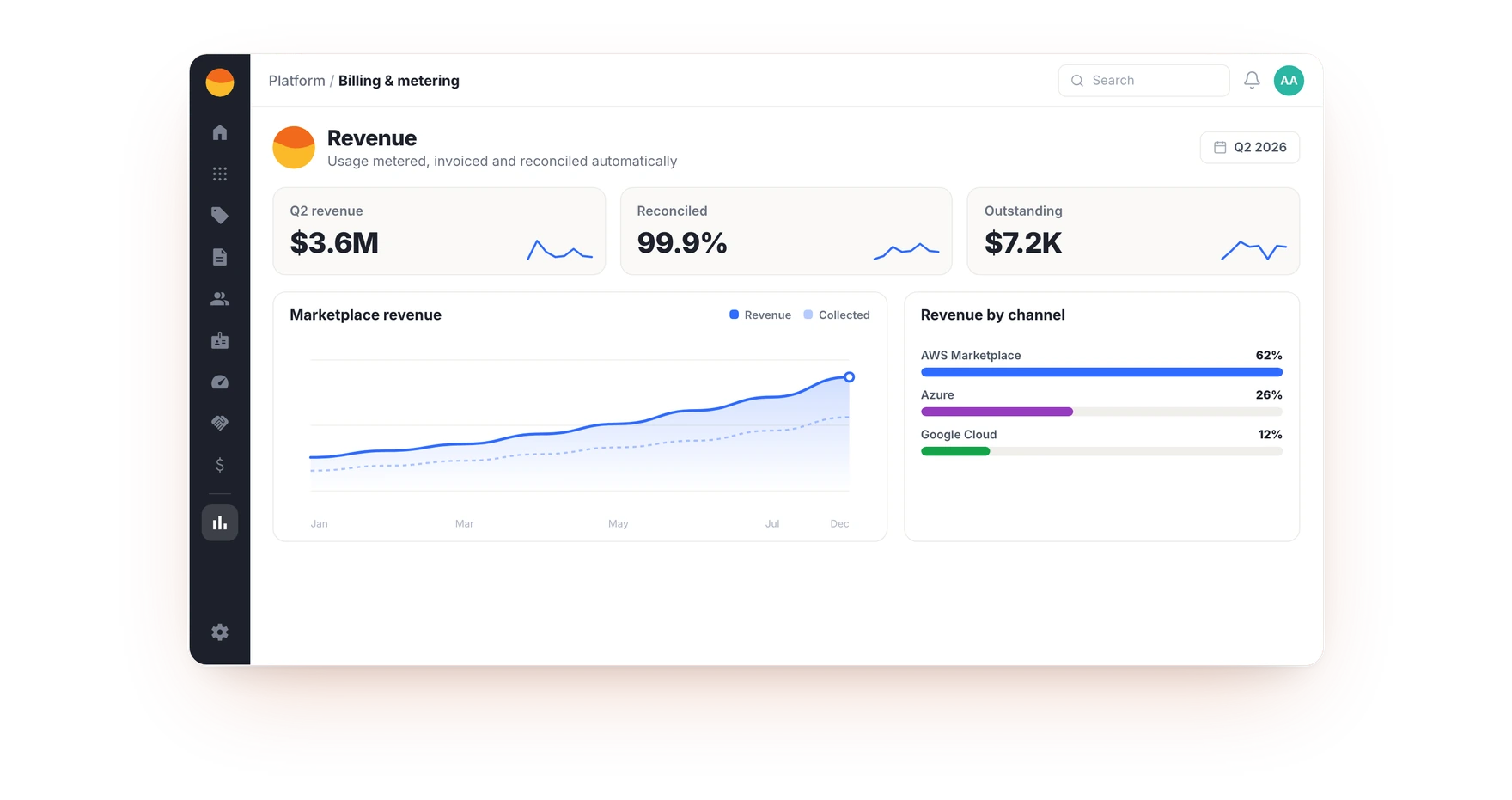
Illustrative sample data — not customer results.
Billing and metering is mission critical.
Build it in-house and it breaks.
The gap between what a customer used and what the marketplace actually paid you is where finance loses its days.
 With Fours
Four steps between a usage event and recognized revenue.
The part of marketplace selling that quietly becomes someone’s month-end job.
Usage arrives from wherever you already measure it.
Send events straight from your product through the API, or connect the metering platform you already run. Either way the usage is normalized into one shape before anything is priced, so a customer on AWS and a customer on Azure are counted the same way.
Usage API Lago
 Metronome
 Orb Normalized across sources Your product or metering platform Fours Normalized usage
 Usage metering Received usages, normalized 48.2K events
| Record | Buyer | Reported |
|---|---|---|
| rec-8f21a | Acme Corp | 2 min ago |
 rec-8f19c | Umbrella | 5 min ago |
 rec-8f04b | Globex | 12 min ago |
Illustrative sample data — not customer results.
Priced against the plan the buyer actually bought.
Pricing rules apply the tiers, volume discounts and overages on the offer that buyer accepted, rather than a list price someone has to remember to adjust. Every event is validated, and records that fail are retried instead of quietly disappearing.
Tiers Volume discounts Overages Event validation Automatic retries Fours Priced usage Priced usage Pricing applied to metered records Validated | Dimension | Included | Rate |
|---|---|---|
| API requests | 5M | $0.010 |
| Data processed | 10 TB | $0.008 |
| Active seats | 250 | Committed |
Illustrative sample data — not customer results.
Reported to the marketplace that has to bill it.
Metering records go to AWS, Microsoft or Google Cloud on the schedule each one expects, so the buyer is charged on their own cloud bill against the commitment they already made. A rejected record surfaces as an alert rather than a gap you find at month end.
AWS  Microsoft Google Cloud Metering APIs Rejection alerts Fours The marketplace Channel performance Revenue by channel · 90 days Live
Illustrative sample data — not customer results.
The money that lands, matched to the deal that earned it.
Marketplace disbursements are matched automatically against expected revenue and the opportunity that produced them, then exported for revenue recognition. Finance closes against records rather than assembling them first.
Disbursement matching Revenue recognition NetSuite
 QuickBooks
 Stripe
 Chargebee Marketplace disbursement Fours Finance systems Cash & disbursements Marketplace payouts and Stripe Reconciled
| Buyer | Expected | Status |
|---|---|---|
| ITProCloud GmbH | $4,726 | Received |
| Acme Corp | $12,400 | Scheduled |
Illustrative sample data — not customer results.
Frequently asked questions
From finance teams closing the books on marketplace revenue.
What is marketplace metering?
Reporting how much a customer used your product to the marketplace that bills them, so the charge lands on their cloud bill accurately and on time.
Can we keep the metering platform we already use?
Yes. Usage can come straight from your product through the API, or from Lago, Metronome or Orb. It is normalized into one shape either way.
How is revenue leakage prevented?
Every usage event is validated before it is reported, failed records are retried automatically rather than dropped, and marketplace disbursements are reconciled against expected revenue so a shortfall surfaces instead of hiding.
Which finance systems are supported?
NetSuite, QuickBooks, Stripe and Chargebee, with exports shaped for revenue recognition.
Can we meter across more than one marketplace at once?
Yes. Usage is reported to AWS, Microsoft and Google Cloud on the cadence each one expects, from one place.
What happens when a metering record is rejected?
It is flagged as an alert and retried. The point is that a rejected record is something you hear about when it happens, not something finance discovers at month end.






































Customer outcomes
More partner-driven growth.
Less operational drag.
Marketplace revenue, co-sell referrals and partner programs, run by teams who moved off spreadsheets and portals.
Your marketplace revenue,
already reconciled.
Thirty minutes on your billing motion and where the manual work is today.
See Fours in actionUsage to revenue, one system